Appliance Repair School Versus Apprenticeship
Compare appliance repair school versus apprenticeship for cost, speed, mentorship, and field readiness, then choose a path built for your career goals.
A customer is standing in front of a refrigerator full of groceries. The compressor is running, the evaporator fan is quiet, and the temperature is climbing. Can you work the diagnostic process, explain the issue clearly, and create a job ticket that earns trust? That is the real question behind appliance repair school versus apprenticeship. Both paths can lead to paid work, but they build technician confidence in very different ways.
For career changers and future service-business owners, the best choice is rarely about which path sounds more traditional. It is about how quickly you can build repeatable diagnostic skills, get exposure to multiple appliance categories, and become ready to produce results in the field.
What an Apprenticeship Actually Delivers
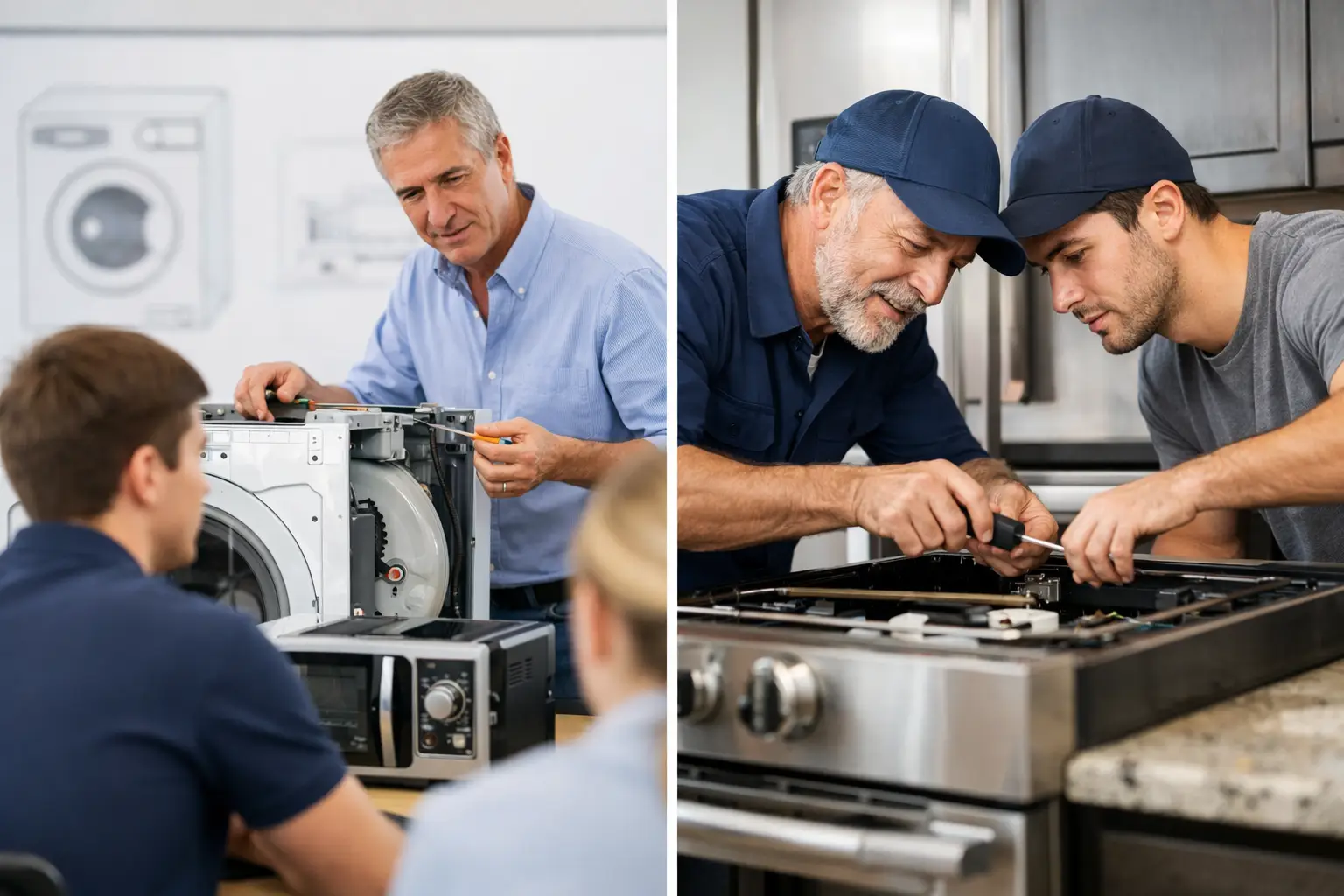
An apprenticeship puts you close to real service calls. You may ride with an experienced technician, help move appliances, pull panels, locate model numbers, carry tools, and observe customer conversations. In a strong shop, you will also see how a technician manages a packed route, handles parts delays, and works safely inside a customer's home.
That field exposure matters. Appliance repair is not only a technical trade. It is a service operation where access issues, pets, tight laundry closets, upset customers, and incomplete error-code information can affect the job. An apprenticeship can teach the rhythm of the business in a way that is difficult to simulate fully.
The trade-off is consistency. Your education depends on the company, the technician assigned to you, and the calls that happen to come in that week. A busy shop may need help with installs, maintenance work, or repetitive high-volume repairs before it has time to explain control-board logic or sealed system fundamentals. You can learn a great deal by watching, but watching is not the same as owning the diagnostic process.
Some apprenticeships are paid. Others begin as low-paid helper positions. Some companies will train a new technician across refrigeration, laundry, cooking, dishwashers, and microwaves. Others may keep you in one lane because that is where the immediate workload is. Ask direct questions before you commit: Who trains me? How many service calls will I observe each week? Will I use a multimeter? Will I learn diagnostics or mainly assist?
What Appliance Repair School Builds First
A structured appliance repair program starts with the skills that make field work safer and more productive: tool use, electrical fundamentals, lockout/tagout practices, voltage testing, resistance testing, wiring diagrams, and diagnostic workflow. Instead of waiting for a failed thermistor or no-heat dryer call to appear on a route, you work through the logic before you arrive at a customer's door.
That foundation is especially useful for adults entering the trade without a mechanical background. A beginner should not have to guess what a thermal fuse does, how to test a door switch, or why a board is not automatically the failed part just because it is expensive. Training gives you a sequence: verify the complaint, inspect, test power and components, interpret readings, isolate the fault, document the repair, and communicate the next step.
A good school also gives you category breadth. You need exposure to laundry appliances, refrigerators, freezers, ranges, ovens, cooktops, microwaves, and dishwashers because service companies and independent customers do not schedule their breakdowns around a single specialty. A technician who understands defrost systems, gas and electric heat circuits, water valves, drain paths, and electronic controls can pursue more work than someone trained only on the calls their first employer happened to receive.
The limitation is obvious: school does not replace time in occupied homes. You still need hands-on repetition with tools, real appliances, and customer interactions. The strongest use of training is not to avoid the field. It is to enter the field with a framework that helps you learn faster and make fewer expensive mistakes.
Appliance Repair School Versus Apprenticeship: The Core Differences
The biggest difference is control. In a school-based program, the curriculum is built around the competencies a new technician needs, not around the route schedule of one local company. You can study a dishwasher circulation problem one day and a refrigerator defrost failure the next, even if neither call is currently on a shop's board.
An apprenticeship offers more immediate context. You may see how a technician protects flooring, quotes a repair, collects payment, and decides whether a repair is financially sensible for the customer. Those are valuable operational lessons, particularly if your goal is to run your own route one day.
Speed can favor structured training when your schedule needs flexibility. A 12-week program lets a motivated learner move through a defined path and practice the same diagnostic decision-making repeatedly. An apprenticeship may take longer to develop the same breadth because training happens around production demands. But if you have access to a reputable employer with a patient mentor and steady call volume, an apprenticeship can accelerate real-world judgment.
Cost works differently, too. Apprenticeships may reduce upfront education costs, especially when the employer pays you while you learn. The price can be lower control over the pace and scope of your development. Paid training programs require an investment, but they can be easier to evaluate because the curriculum, support, assessments, and included tools are clear before you enroll.
Why a Hybrid Path Usually Wins
For most new technicians, this is not an either-or decision. Structured education followed by field experience is often the strongest route. Learn how circuits work before you are expected to troubleshoot one under pressure. Learn diagnostic discipline before a customer is waiting for an answer. Then use an apprenticeship, helper role, or entry-level service position to sharpen speed, customer communication, and hands-on execution.
This approach also makes you more useful to an employer from day one. Instead of arriving with only enthusiasm, you can speak the language of testing. You understand that a symptom is not a diagnosis. You know why a technician checks supply voltage, continuity, resistance, airflow, water flow, and fault codes before recommending a part. That reduces the amount of basic instruction a lead technician has to provide on a packed route.
For someone pursuing business ownership, the hybrid path is even more practical. Technical skill creates the repair. Documentation, pricing, scheduling, parts research, and customer-ready reporting create a service business. You need both sides if your goal is to build a profitable operation rather than remain dependent on another technician's decisions.
What Field-Ready Training Should Include
Do not choose a program based only on the word certification. Ask what you will actually be able to do after completion. A meaningful training path should cover electrical safety, multimeter use, component testing, wiring reference navigation, and fault isolation. It should also address the appliance systems you will see on a typical route, from washer drain failures to refrigerator temperature complaints.
Scenario-based practice is a major advantage because it forces a decision. Reading a manual can tell you what a thermistor is. Working through a no-cool scenario requires you to decide what to test first, what reading matters, and when to stop replacing parts blindly. That is the difference between information and technician thinking.
Look for business and communication training as well. Customers need a plain-language explanation, not a lecture on control logic. Employers need complete notes. You need to know how to document model and serial information, test results, recommended repairs, parts needs, and customer approval. These details protect the company, reduce callbacks, and make you easier to hire.
Appliance Repair Academy is built around that field-ready sequence: 12 weeks of training, 90-plus scenario-based simulations, graded coursework, a final certification assessment, instructor and community support, and a 12-month subscription to an AI field tool that supports error-code lookup, wiring references, multimeter guidance, photo-based fault detection, job ticketing, and customer reporting.
Choose Based on Your Starting Point
If you already have a job offer with a company that has a proven training culture, a working mentor, and regular opportunities to diagnose appliances yourself, an apprenticeship can be an excellent launchpad. Get the expectations in writing where possible, and make sure your role progresses beyond helper work.
If you need a flexible path, want broader category knowledge before applying for jobs, or plan to build your own service business, structured training may give you a cleaner starting line. It can also make it easier to approach employers with evidence that you have completed coursework, practiced diagnostics, and understand safety.
If you can combine both, do it. Build the knowledge base first or alongside your first field role, then let real calls teach you the unpredictable parts of the trade. The technician who can test with confidence, document clearly, and keep learning will have more options than the technician who only knows one shop's habits.
Appliance Repair Academy is built for exactly this kind of field-ready start: 12 weeks of structured training, 90-plus scenario-based simulations, graded coursework, a final certification assessment, instructor and community support, and a 12-month subscription to our AI field assistant. Explore the full program at https://appliancerepairacademy.org to see what structured technician training can look like, then download the companion Appliance Repair AI app at https://appliancerepairai.org/download to support your diagnostic process on real jobs: error-code lookup, wiring references, multimeter guidance, photo-based fault detection, job ticketing, and customer reporting in your pocket. Your first service call will not be perfect, but a repeatable workflow gives you a professional place to start.