Washer Vibration Troubleshooting Training That Pays
Washer vibration troubleshooting training teaches a repeatable diagnostic workflow for suspension, leveling, bearings, and profitable field repairs now.
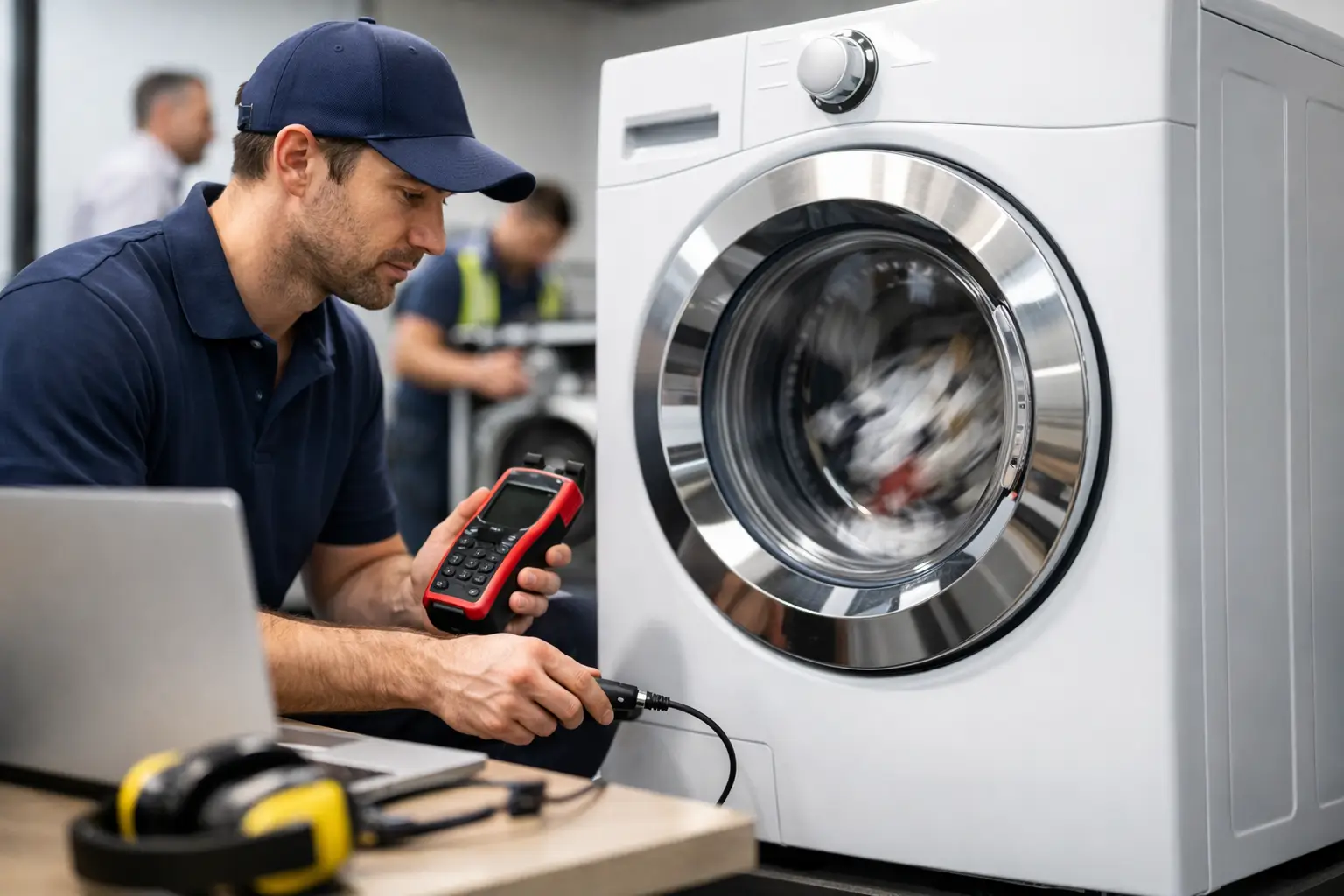
A washer that walks across a laundry room is not a “level the feet and leave” service call. For a working technician, washer vibration troubleshooting training builds the diagnostic discipline to separate a basic installation issue from a worn suspension system, failed tub bearing, broken counterweight, or overloaded customer habit. That difference protects your callback rate, your parts margin, and your reputation.
A customer may describe the complaint as shaking, banging, thumping, moving, roaring, or “going crazy on spin.” Those are symptoms, not diagnoses. The technician who earns repeat work is the one who can control the test, isolate the mechanical cause, document the findings, and explain the repair in plain language.
Why Washer Vibration Calls Matter in the Field
Laundry appliances produce frequent service opportunities because they combine water, high-speed motion, electronics, drive components, and customer use patterns. Vibration complaints can look simple from the doorway, but they reward a structured process. A machine may only vibrate with towels, only at high spin, only when it reaches final extraction, or only after the homeowner moved it to a new floor.
That is why guessing is expensive. Replacing shocks on a front-load washer with a failing tub bearing can create a return trip. Blaming the floor before checking a loose concrete counterweight can miss the actual safety issue. Telling a customer to use smaller loads without verifying suspension movement can turn a legitimate repair into a frustrated review.
For career changers, these calls are valuable training ground. They teach you to combine visual inspection, customer interview skills, cycle observation, mechanical testing, and electrical awareness. The same workflow carries into dryers, dishwashers, refrigerators, and other appliances where the first complaint is rarely the whole story.
Start With Safety and the Customer’s Complaint
Before moving a washer, disconnect power and shut off water if hoses, valves, or rear-panel access are involved. Use lockout/tagout practices when the work setting requires it. A washer can shift unexpectedly during a spin test, and a damaged power cord, leaking hose, or loose cabinet panel adds risk to what started as a vibration complaint.
Ask the customer when the vibration began and what changed. Did they install the washer themselves? Was the unit recently relocated? Does it happen with every load or only bulky items? Has the machine displayed an unbalanced-load code? Did they hear metal-on-metal noise before the shaking started?
These questions narrow the path, but do not replace inspection. A customer may call normal out-of-balance behavior “violent shaking,” while another may have tolerated a damaged bearing for months. Treat the story as evidence, then verify it.
Rule Out Installation Problems First
Many vibration calls begin with the foundation. Confirm all four feet make firm contact with the floor and the cabinet does not rock when you press opposite corners. Leveling is not simply about making the cabinet visually straight. The washer must be stable under dynamic load, with locking nuts secured after the feet are adjusted.
Check the floor as well. A solid concrete slab behaves differently than an older second-floor laundry closet with flexible framing. A stable washer can still transmit vibration through a weak floor, especially during high-speed spin. In that situation, the correct recommendation may include load-management guidance or a contractor evaluation rather than selling unnecessary appliance parts.
For recently installed front-load washers, confirm the shipping bolts were removed. Leaving them in place restricts tub movement and can cause severe noise, cabinet movement, and component damage. This is a high-value catch because it is quick to verify, easy to document, and critical to correct.
Washer Vibration Troubleshooting Training: Follow the Spin System
Once installation is verified, inspect the components that control tub movement. On a top-load washer, that may include suspension rods, springs, tub centering hardware, the drive system, and basket support. On a front-load model, focus on shocks, springs, the outer tub, concrete counterweights, drum spider support, and the bearing assembly.
With the machine unplugged, press down on the tub or basket and release it. The exact feel depends on the design, but excessive bouncing, a tub that sits off-center, or a sharp clunk points toward a suspension issue. Compare movement side to side. A single weak shock or damaged rod can create a problem that only appears when a load shifts during spin.
Inspect for oil residue around dampers, cracked plastic suspension components, broken springs, loose mounting pins, and damaged tub supports. On front-load units, check counterweight bolts and the concrete blocks themselves. A loose or cracked counterweight can create a heavy knocking sound that customers may describe as a bad bearing.
Then rotate the empty basket or drum by hand. Grinding, rumbling, roughness, or excessive play can indicate bearing damage. On many front-load washers, lifting the stainless drum at the door opening and feeling vertical movement is a useful screening test. Significant play between the inner drum and outer tub often points to a bearing or spider problem, but the repair decision depends on the model, parts availability, labor, and overall machine condition.
A failing bearing is not always a profitable repair for the customer. Some machines require substantial teardown or a complete outer tub assembly. Your job is not to force every repair. Your job is to present an accurate diagnosis, explain the labor reality, and offer a recommendation that makes economic sense.
Test the Machine Under Controlled Conditions
An empty spin test can reveal cabinet contact, drivetrain noise, or a loose component, but it does not duplicate every load-related complaint. If the appliance is safe to operate, observe a controlled test with a balanced load. Watch the tub as it accelerates. Does it repeatedly strike the cabinet? Does the machine stabilize and then begin shaking at a certain speed? Does it fail to distribute the load and abort spin?
Pay attention to the sequence. A machine that bangs immediately may have a suspension or installation issue. One that becomes loud only at high RPM may have bearing wear, a damaged basket, or a drive-related problem. A unit that repeatedly fills, tumbles, drains, and retries may have an out-of-balance detection issue, weak suspension, or a customer loading pattern that needs correction.
Do not bypass safety switches or defeat the lid lock just to watch a live spin. Use manufacturer-approved diagnostic procedures. If electronic symptoms are present, retrieve fault codes and consult the model-specific service information. Modern washers use motor feedback, hall sensors, pressure sensing, and control-board logic to manage imbalance. Mechanical inspection and electrical diagnostics should support each other.
Know the Difference Between a Repair and a Customer Education Call
Not every vibration complaint needs a part. A customer washing one heavy bath mat, a single comforter, or a small load of absorbent items can create an imbalance that even a healthy washer cannot correct. Explain how to distribute items, avoid mixing one heavy article with lightweight clothing, and use the appropriate cycle.
That said, customer education should follow verification, not replace it. If a properly balanced test load still produces excessive tub travel or cabinet movement, continue the diagnosis. A technician who dismisses every vibration complaint as “how they load it” will miss real failures and lose trust.
Clear documentation matters here. Record the model and serial number, customer complaint, floor condition, installation findings, observed test results, fault codes, measurements, recommended repair, and any usage guidance provided. Good job notes protect the business and make future service easier if the customer calls again.
Turn a Noisy Complaint Into Technician-Level Skill
Washer vibration work is a strong example of why appliance repair is more than swapping parts. You are reading a mechanical system under load, checking installation variables, using service data, and making a repair-versus-replace recommendation that respects the customer’s budget.
At Appliance Repair Academy, students build this kind of repeatable diagnostic thinking through structured training, technician-built scenarios, graded coursework, and more than 80 simulations. The goal is workforce readiness: arrive with a process, use the right tools, produce clear documentation, and keep moving toward paid service work or your own repair business.
Explore Appliance Repair Academy training content and use the companion AI diagnostic app alongside hands-on practice. The technician who can explain why a washer is vibrating is not just fixing a noisy machine - they are building the confidence customers pay for.