Appliance Repair Certification That Builds Field Skills
Appliance repair certification teaches electrical testing, fault diagnosis, and customer documentation for paid service work and business ownership today.
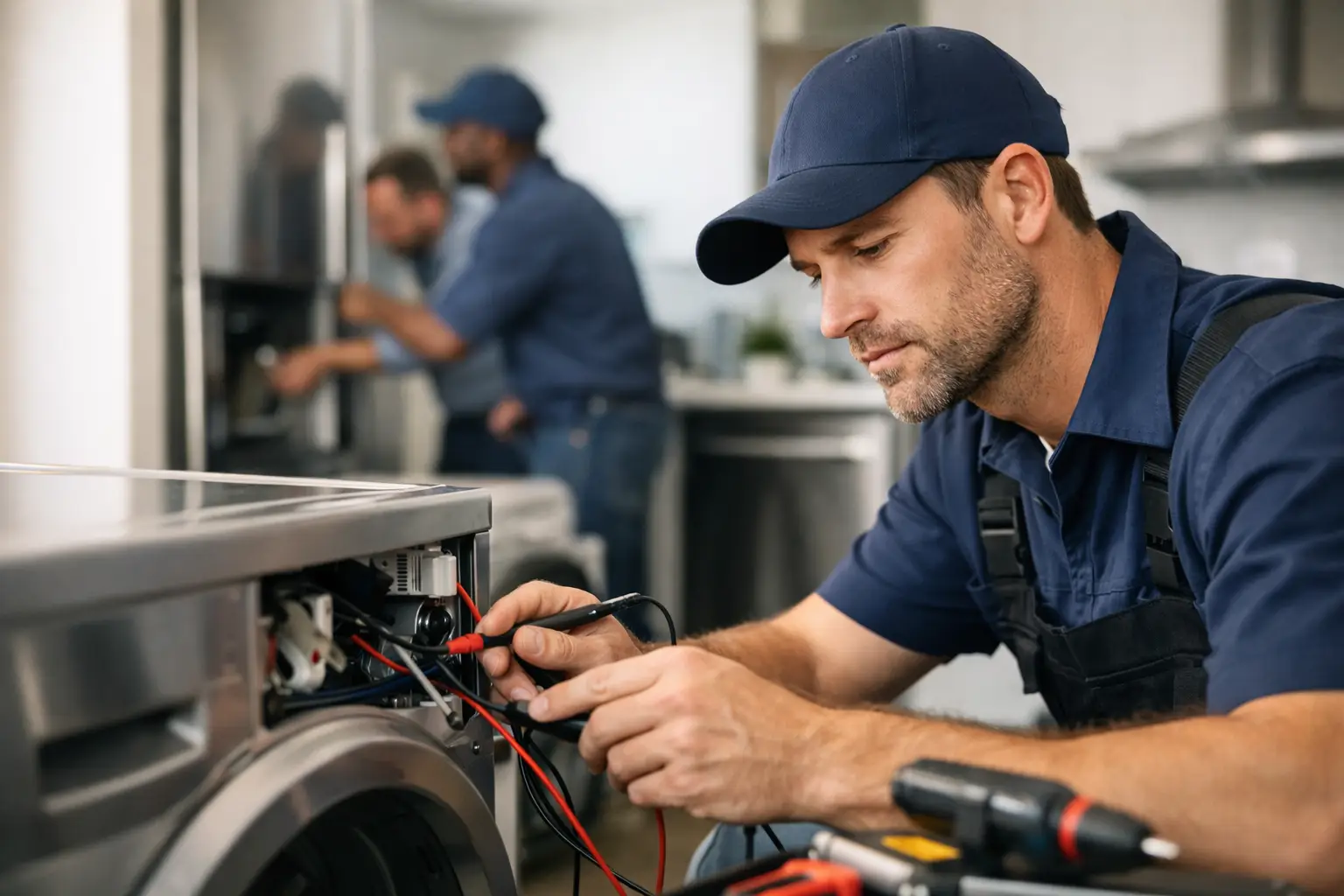
A customer does not care whether a technician watched a few repair videos. They care whether that technician can arrive safely, test the circuit correctly, identify the failed part, explain the repair, and leave the kitchen or laundry room working again. That is the standard a serious appliance repair certification should prepare you to meet.
For career changers and future service-business owners, certification is not just a credential to add to a résumé. It is a structured way to build the diagnostic habits that turn confusing no-cool calls, dead dryers, leaking dishwashers, and microwave complaints into organized repair decisions. The goal is paid, repeatable field work - not memorizing model numbers or guessing at parts.
What Appliance Repair Certification Should Actually Prove
A quality appliance repair certification signals that you have completed organized training and passed an assessment covering the work technicians perform. That generally includes safety procedures, basic electricity, component testing, appliance systems, diagnostics, and customer documentation.
It does not mean you will know every brand, model, or unusual failure on day one. Experienced technicians still encounter unfamiliar platforms, intermittent faults, and previous repairs done incorrectly. Certification gives you the framework to work through those jobs without skipping the fundamentals: verify the complaint, confirm power and safety conditions, test the circuit, isolate the fault, confirm the repair, and document the result.
That distinction matters. A certificate based only on attendance may show that you completed a course. A certification earned through graded coursework, realistic scenarios, and a final assessment offers stronger evidence that you can apply what you learned under job-like conditions.
There is also a separate credential to understand if you plan to work on refrigeration equipment. Technicians who handle regulated refrigerants need the appropriate EPA Section 608 certification. Appliance training can teach sealed system fundamentals, refrigeration diagnostics, and safe workflow, but it does not replace the federal requirement for refrigerant handling.
The Field Skills That Make Certification Valuable
Appliances are electrical, mechanical, and increasingly electronic systems. Good training starts with the non-negotiables before moving into appliance categories.
Safety and electrical testing come first
Before testing a board, motor, heater, or compressor circuit, a technician must know how to protect themselves and the customer’s property. That includes lockout/tagout practices, verifying voltage, managing energized testing carefully, using a multimeter correctly, and understanding where electrical hazards exist.
Electrical fundamentals are the difference between informed diagnosis and parts swapping. You should be able to read voltage, continuity, resistance, and basic circuit paths; recognize when a thermal fuse is open; and understand why a component can look normal but fail under load. Those skills transfer from a dryer heating circuit to a dishwasher circulation issue or a refrigerator defrost complaint.
Category training builds range
Entry-level technicians become more useful when they can work across the appliances customers actually own. A complete program should cover laundry appliances, refrigerators, cooking equipment, microwaves, and dishwashers rather than treating each category as a separate, expensive course.
The work is different across categories. A washer may require drain-pump, lid-lock, suspension, or control diagnosis. A refrigerator no-cool call can involve airflow, defrost systems, fans, thermistor diagnostics, or sealed system fundamentals. An oven may involve igniters, elements, temperature sensors, or relay circuits. The technician’s process stays consistent even as the components change.
Diagnostic workflow prevents expensive mistakes
The fastest technician is not always the person who moves fastest. It is the person who follows a repeatable workflow and avoids unnecessary parts, return trips, and callbacks.
A strong workflow begins by listening to the customer’s description, checking the model and serial information, reviewing error codes, and confirming the symptom. From there, you inspect the obvious conditions, test the relevant circuit, compare readings against expected values, and verify the failure before recommending a repair.
This approach protects your reputation. Quoting a control board when the actual problem is a broken wire, failed door switch, blocked vent, or loose connection can turn a straightforward service call into an expensive callback.
Why Simulations Matter Before Your First Service Call
Hands-on work is essential in the trades, but simulations have a real role when they are built around technician decision-making. They let new technicians practice reading symptoms, choosing tests, interpreting meter readings, and narrowing faults without risking a customer’s appliance or wasting parts.
The best scenarios do not hand you the answer. They make you work through the same questions that come up in the field: Is there incoming power? Is the component receiving the correct voltage? Is the sensor reading plausible? Does the wiring diagram support the diagnosis? What needs to be documented before a part is ordered?
That is why Appliance Repair Academy combines 80-plus scenario-based simulations with graded coursework and a 75-question final certification assessment. Students build from safety and electrical testing into laundry, refrigeration, cooking, microwave, and dishwasher diagnostics over a structured 12-week program.
For someone changing careers, this structure removes a common problem with informal learning: knowing a few repair tricks without knowing what to do when the trick does not work. You need a process that holds up on different brands, different homes, and different customer complaints.
Certification Is Also a Business Readiness Tool
Technical competence gets you through the door. Professional operations help you earn repeat business once you are there.
Service companies want technicians who can communicate clearly, record findings, make sensible repair recommendations, and close out jobs properly. Independent operators need the same skills, plus the ability to manage scheduling, pricing, job tickets, invoices, and customer expectations. A repair completed without good documentation can still become a problem if the customer does not understand what was tested, what failed, and what was replaced.
This is where career-focused certification programs separate themselves from theory-only courses. Training should address customer-ready reports, diagnostic notes, repair estimates, and the operational decisions involved in building a service route. You may start by applying to an established repair company, then use that experience to build an independent business. Or you may pursue ownership sooner. The right path depends on your comfort with sales, scheduling, local demand, and the capital you have for tools and parts.
A six-figure business path is possible, but it is not automatic. It requires technical accuracy, consistent customer service, efficient routing, and the discipline to protect margins. Certification gives you a starting system. Your field experience and operating habits determine how far you take it.
How AI Supports Technicians Without Replacing Them
AI is useful in appliance repair when it shortens research time and helps technicians stay organized. It is not a substitute for verifying voltage, inspecting wiring, or using judgment around safety. A photo-based fault suggestion is a lead to investigate, not a license to skip testing.
Used correctly, diagnostic technology can help a new technician look up error codes, reference wiring information, follow multimeter guidance, create job tickets, and produce customer-ready reports. That reduces the time spent hunting through scattered manuals and helps keep the repair process consistent.
Paid Appliance Repair Academy tuition includes a 12-month subscription to the Appliance Repair Assistant AI app. The practical advantage is having field support connected to the training workflow, from initial symptom review to documented repair results. The technician still owns the diagnosis. The tool helps make the work faster, clearer, and easier to record.
Choosing a Certification Program
Before enrolling, look past marketing language and ask what you will be able to do by the end. Does the course teach electrical testing before appliance-specific repairs? Does it cover multiple appliance categories? Are there graded assignments and a final assessment? Can you practice realistic diagnostic decisions? Is instructor support available when a concept does not click?
Also consider the total path to workforce readiness. A low-cost course that covers only one appliance type may leave you paying again for refrigeration, cooking, dishwashers, or business training. A program that bundles broad technical coverage, diagnostic simulations, support, and field tools can be the better value if your objective is to begin earning sooner.
Explore certification training resources through Appliance Repair Academy and use the Appliance Repair Assistant AI companion app to support your diagnostic practice in the field. The next repair becomes less intimidating when you can explain what you tested, why it failed, and what the customer should expect next.