Can Online Training Teach Repairs? What It Takes
Can online training teach repairs? Learn what builds field-ready appliance technicians: safety, diagnostics, simulations, feedback, and hands-on practice.
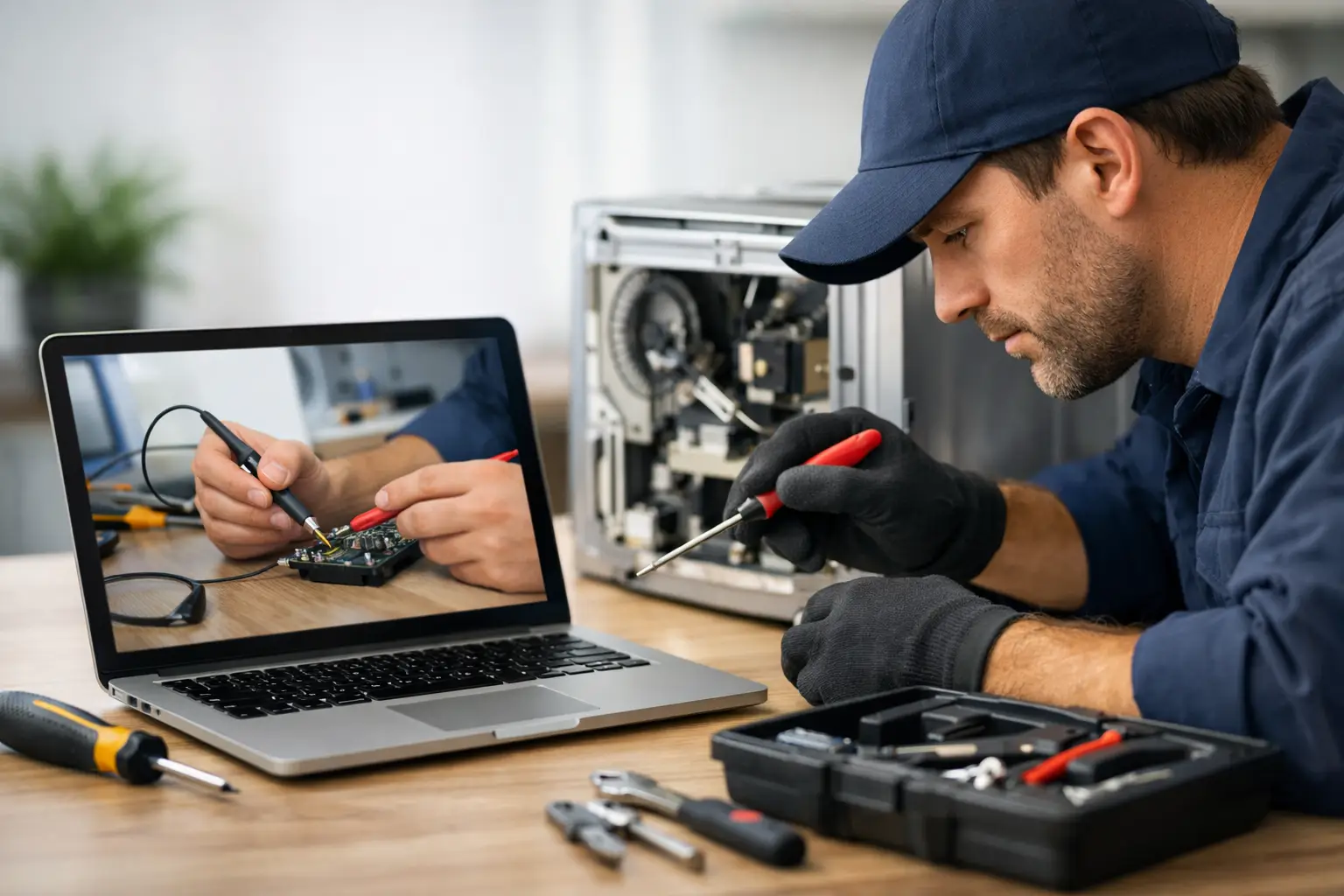
A service call rarely begins with a clean diagnosis. A customer says the dryer “stopped heating,” the display shows a code that may or may not matter, and the machine is installed in a tight laundry closet. The technician has to protect the customer’s home, verify the complaint, test safely, and make a decision that holds up when the unit is reassembled.
That is the real question behind can online training teach repairs. It can teach the knowledge, diagnostic process, and professional workflow that make a repair technician valuable. But it has to be built for field decisions, not passive video watching. The best online repair training does not pretend a screen can replace touching a multimeter or pulling a washer apart. It prepares you to do those hands-on tasks with a repeatable plan.
Can Online Training Teach Repairs in the Real World?
Yes, when the program teaches technicians how to think before it asks them to memorize parts. Appliance repair is a hands-on trade, but much of a technician’s success happens before a screw is removed. You need to read a wiring diagram, understand the appliance sequence of operation, isolate a failed component, and know when a measurement is unsafe or inconclusive.
Online instruction can teach those skills effectively because diagnostics follow logic. A refrigerator that is not cooling, a dishwasher that will not drain, and a range with a dead surface element each leave clues. Good training shows you how to move from symptom to test point to repair recommendation without guessing. That reduces return trips, unnecessary parts purchases, and the costly habit of replacing components until something works.
The limitation is equally clear: watching someone use a meter is not the same as placing your own meter leads, selecting the correct setting, and interpreting a live reading. Students still need practical repetition. They need to identify connectors, remove panels, work around sharp sheet metal, and follow lockout/tagout procedures. Online training is strongest when it provides the blueprint for that practice and pushes learners to use it deliberately.
What a Field-Ready Online Repair Course Must Teach
A course should begin with safety and electrical fundamentals, not jump straight into error codes. Appliance technicians work around line voltage, stored energy, moving components, hot surfaces, refrigerant systems, and microwave high-voltage circuits. A student who can name a failed part but cannot de-energize equipment, confirm voltage correctly, or recognize a dangerous condition is not ready for a customer’s home.
From there, the training should build diagnostic habits. That means understanding voltage, resistance, continuity, current flow, switches, relays, motors, heaters, thermistors, control boards, and wiring paths. These are not separate trivia categories. They are the working language behind most residential appliance failures.
Category training matters too. Laundry appliances, refrigeration, cooking equipment, microwaves, and dishwashers have different failure patterns and access challenges. A technician needs more than a broad introduction to “appliance repair.” They need to understand, for example, why a dryer can tumble without heating, how defrost failures affect refrigerator temperatures, what a dishwasher’s drain path is supposed to do, and when sealed system fundamentals call for a different level of equipment and certification.
Just as important, the course should teach a workflow a new technician can use on every call: confirm the complaint, inspect for obvious issues, verify power and operating conditions, consult technical information, test the likely circuit, document findings, quote clearly, and verify the repair. That workflow is what turns scattered knowledge into paid work.
Simulations Create Repetition Before the Service Call
Scenario-based simulations are one of the biggest advantages of a well-built online program. They give students multiple chances to work through the same decision pattern without risking a customer’s appliance or wasting parts. A simulation can ask what to test next after a no-start complaint, present a multimeter reading, introduce an error code, and require the student to explain the repair recommendation.
That is more demanding than a multiple-choice quiz about appliance vocabulary. It requires diagnostic sequencing. If a student jumps to a control board before confirming incoming voltage, the course should show why that path is weak. If they identify a failed thermistor but overlook a damaged harness, the lesson should reinforce the inspection step.
Appliance Repair Academy uses more than 80 scenario-based simulations alongside graded coursework because technicians are paid to make sound decisions under imperfect conditions. The goal is not to create a person who has seen a repair video. The goal is to build someone who can arrive at a reasonable next test and explain the result.
Instructor Feedback Prevents Expensive Bad Habits
Self-paced content gives adults flexibility, especially career changers working a current job. But total isolation can create blind spots. A beginner may misunderstand a diagram, confuse a resistance reading with a voltage measurement, or use a repair shortcut that is unsafe.
Direct instructor and community support give students a place to pressure-test their reasoning. That matters when the question is not simply “What part is bad?” but “What evidence proves it?” Experienced guidance also helps students understand the trade-offs: a repair may be technically possible but not financially sensible for the customer, or a sealed system issue may require specialized equipment beyond an entry-level service call.
How Online Learning Becomes Hands-On Skill
The student has a role in making online training work. Treat the course as a job-preparation system, not entertainment. Build a basic practice routine around safe, controlled exposure to real equipment. Start with unplugged appliances and non-energized components while learning disassembly, connector identification, wire tracing, and meter setup. Then move into supervised or carefully planned live testing only after electrical safety and measurement fundamentals are solid.
Old appliances, donated units, salvage parts, and clearly documented practice setups can be useful. The objective is not to collect broken machines. It is to practice specific actions: removing a dryer heating element, checking a door switch, tracing a dishwasher drain circuit, reading a refrigerator thermistor chart, or comparing a wiring diagram to the appliance in front of you.
Keep a technician-style record of each exercise. Write the customer-style complaint, list your observations, record each test and reading, state your conclusion, and note what you would quote or recommend. This habit prepares you for job tickets and customer-ready reporting. It also exposes weak logic quickly. If you cannot explain why you condemned a component, you probably need another test.
An AI diagnostic tool can support this process, but it should not replace it. Photo-based fault detection, error-code lookup, wiring references, and multimeter guidance can speed up information gathering in the field. The technician still owns the diagnosis. You must verify model information, use safe testing procedures, and decide whether the evidence supports repair, replacement, or referral.
The Difference Between Course Completion and Work Readiness
Completing an online course does not automatically make someone an expert technician. Neither does completing an in-person class. Expertise comes from repetitions across real brands, models, installation conditions, and customer conversations.
What structured online training can do is shorten the path to productive repetition. Instead of learning through random job shadowing or scattered manuals, you begin with a foundation. A 12-week program that covers safety, electrical testing, major appliance categories, diagnostic workflows, documentation, and business operations gives a new technician a usable operating system.
A final certification assessment also matters when it measures applied knowledge rather than attendance. A 75-question final exam, graded work, and simulation performance create accountability. They show whether a student can recognize circuit logic and service procedures before relying on that knowledge in paid work.
For someone pursuing employment, this structure makes it easier to speak confidently with service companies about what they know: safe testing, common appliance systems, repair documentation, and diagnostic method. For an aspiring owner, it creates a better starting point for building pricing, scheduling, customer communication, and a professional service process.
Is Online Appliance Repair Training Right for You?
Online training is a strong fit if you want a flexible route into a practical trade and are willing to do the work beyond the videos. It is especially useful for adults balancing a job, family responsibilities, or a move into self-employment. You can build technical knowledge on your schedule while preparing for the tools, practice, and real service exposure that follow.
It may be a weaker fit if you expect a certificate alone to create instant mastery, or if you have no interest in handling tools, reading diagrams, or communicating with customers. Appliance repair rewards people who like solving physical problems and taking ownership of the outcome.
The opportunity is real because appliances keep failing, customers need service quickly, and strong technicians create value that cannot be automated from an office. Learn the process, practice it safely, and keep documenting what the evidence tells you. That is how online training becomes a launchpad for a career that can grow into steady employment or your own service business.
Explore the Academy’s training content at appliancerepairacademy.org and pair your hands-on practice with the diagnostic app at appliancerepairai.org/download.