How an Appliance Repair Simulator Builds Field Skills
See how an appliance repair simulator builds diagnostic judgment, safer electrical testing, and job-ready confidence before you enter a customer’s home.
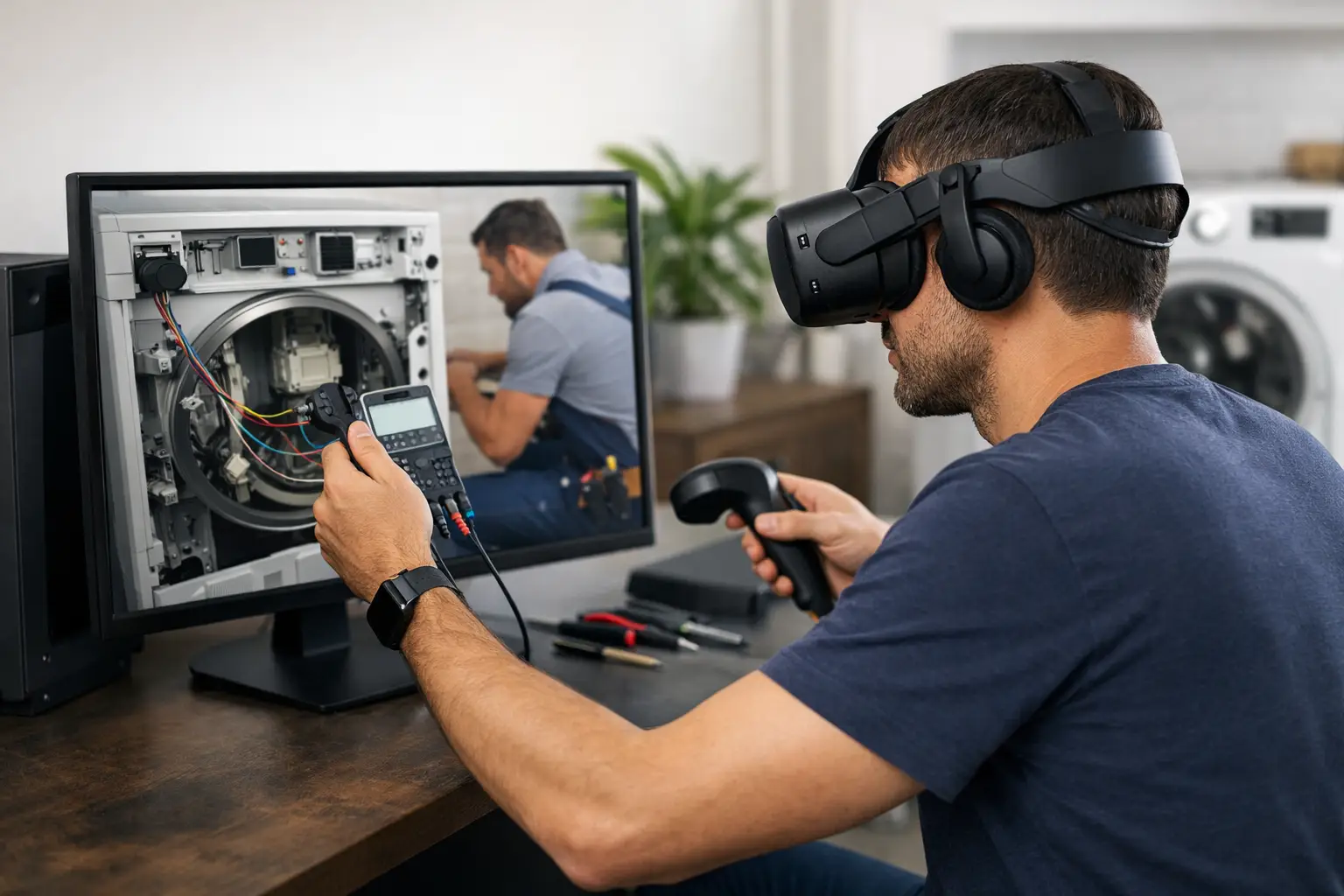
A bad compressor diagnosis can cost a customer hundreds of dollars. A missed loose connection can turn a simple dryer repair into a return trip. An appliance repair simulator gives new technicians a place to make those calls, test their reasoning, and correct mistakes before they are standing in a customer’s kitchen with a truck schedule waiting.
For career changers, simulation training closes a gap that manuals and videos cannot. You do not just memorize what a thermistor does or where a thermal fuse is located. You work through symptoms, choose a diagnostic path, interpret meter readings, and decide what should happen next. That is the habit that separates a parts changer from a technician customers and service companies can trust.
Why an appliance repair simulator matters
Appliance repair is a decision-making trade. The machine may display an error code, but an error code is a starting point, not a final diagnosis. A refrigerator that is warm may have an airflow issue, a failed evaporator fan, a defrost problem, a control issue, or sealed system trouble. The right repair starts with a repeatable workflow, not a guess.
An appliance repair simulator puts that workflow under pressure without the financial risk of a live call. A scenario may present a customer complaint, a model-specific symptom, a wiring reference, and test results that change depending on the checks you choose. Instead of reading a finished case study, you must determine the next action.
That matters because field work is rarely neat. Customers describe symptoms in everyday language. They may say the washer is “stuck,” the oven is “acting weird,” or the dishwasher “doesn’t clean anymore.” Your job is to turn that complaint into a structured diagnostic process: confirm the symptom, make the unit safe, inspect likely failure points, test components, verify the repair, and document the result.
Simulation builds diagnostic judgment, not just recall
A technician needs facts. You need to understand voltage, continuity, resistance, current flow, relays, thermostats, thermistors, switches, motors, and control boards. But technical facts only become valuable when you can apply them in the right order.
Consider a no-heat dryer call. A beginner may immediately suspect the heating element. A trained technician starts more carefully. Is the dryer receiving the correct supply voltage? Is the vent restricted? Is the thermal fuse open? Is the cycling thermostat functioning? Is the element grounded to the housing? Each question eliminates possibilities and protects the customer from an unnecessary part replacement.
A quality simulation makes you practice that order of operations. You learn why a voltage test may be more useful than a continuity test in one situation, and why testing a component disconnected from the circuit can prevent a false reading. You also see the business impact of skipping steps: a wrong diagnosis means lost time, lower profit, and less customer confidence.
This is especially useful for people entering the trade without years of informal job shadowing. You can build pattern recognition faster because you are exposed to many failure paths, not just the handful that happen to appear during a week riding along with another technician.
The value of safe repetition
Hands-on work remains essential. You need to use a multimeter, remove panels, inspect harnesses, manage fasteners, and follow lockout/tagout practices around live electrical equipment. No screen can replace the feel of a seized blower wheel or the real-world challenge of accessing a refrigerator evaporator.
But live equipment is not always available when you need practice, and unsafe trial and error is not training. Simulations provide repeated decision practice between hands-on sessions. You can revisit a failed diagnostic path, compare it with the correct workflow, and understand why the result changed.
That repetition builds confidence without teaching overconfidence. The goal is not to assume every no-start dishwasher has the same failure. The goal is to arrive on site knowing how to isolate the fault logically.
What strong repair scenarios should cover
Not every simulation is equally useful. A simple quiz that asks for a definition has value for review, but it does not recreate a service call. Look for training scenarios that move from a customer complaint through testing, diagnosis, repair verification, and documentation.
Strong appliance repair simulation training should expose you to the systems you will see in the field, including laundry appliances, refrigerators, cooking equipment, microwaves, and dishwashers. The scenarios should also require practical judgment around safety and electrical testing rather than treating those topics as a separate chapter you finish and forget.
The most valuable scenario work tends to include these field realities:
- Incomplete or misleading customer descriptions that require clarification
- Error codes that point toward a circuit or system, not one guaranteed failed part
- Wiring diagrams and component locations that must be interpreted correctly
- Multimeter readings that require you to decide whether voltage, resistance, continuity, or another test is appropriate
- Customer-facing outcomes, including repair notes and a clear explanation of findings
That last point is easy to overlook. A technician can make a correct repair and still create problems if the job ticket is vague, the parts used are not recorded, or the customer does not understand what was repaired. Documentation protects the business, supports future service visits, and makes you look organized from day one.
Where simulations fit in a real training path
A simulator works best as part of a structured program, not as a substitute for every part of technician education. Before diagnosing equipment, you need safety fundamentals, tool familiarity, and a working understanding of electricity. Then you can move into appliance categories and progressively harder failures.
For example, a practical sequence starts with electrical basics and multimeter use. From there, you might diagnose a dryer that will not tumble, then a washer with a drain issue, then a refrigerator with a defrost failure. Later scenarios can introduce control-board logic, sensor circuits, communication faults, and sealed system fundamentals.
This progression matters because the same troubleshooting framework appears across appliances. Verify the complaint. Check power and safety conditions. Inspect. Test. Identify the failed part or system. Confirm the repair. Document the job. The components change, but disciplined process carries across the trade.
At Appliance Repair Academy, students work through more than 80 scenario-based simulations alongside graded coursework, specialized appliance training, and a final certification assessment. The 12-week structure is designed to turn broad information into a usable field process, including the business operations that matter if you plan to run your own route.
AI can strengthen the workflow, but it cannot make the call for you
Diagnostic technology is becoming part of modern field service. Photo-based fault detection, error-code lookup, wiring references, and guided multimeter steps can help technicians work faster and document better. Used correctly, those tools reduce time spent hunting for basic information and keep attention on the machine in front of you.
The trade-off is simple: an app can suggest likely causes, but it cannot safely bypass verification. A recommendation is not proof. A technician still needs to confirm voltage, inspect the circuit, account for the model design, and test the suspected component. That is why simulation-based training is so useful. It teaches you to use information as evidence, not as a replacement for judgment.
For an independent technician, this combination can be a serious advantage. Better diagnostics reduce avoidable part orders and repeat visits. Clear reports help customers understand the value of the repair. Faster access to wiring and fault information gives a newer technician more support without turning every call into a phone call for help.
Train for the moment the customer is waiting
The real test is not whether you can name refrigerator components from memory. It is whether you can walk into a home, listen carefully, work safely, diagnose with discipline, explain the repair clearly, and leave the job documented correctly.
An appliance repair simulator helps you build that readiness before your income depends on it. It gives you more reps, more diagnostic branches, and more chances to understand the consequence of each testing decision. Pair that work with hands-on practice, instructor feedback, and a clear path into paid service work, and appliance repair becomes a trade you can enter with purpose.
Explore more career-training content through Appliance Repair Academy, then use the companion Appliance Repair Assistant AI app to support your hands-on diagnostic practice in the field. The most valuable tool on a service call is still a technician who knows what to test next.