Appliance Certification Versus Informal Training
Compare appliance certification versus informal training to see which path builds safer diagnostics, stronger job options, and skills to build a repair firm.
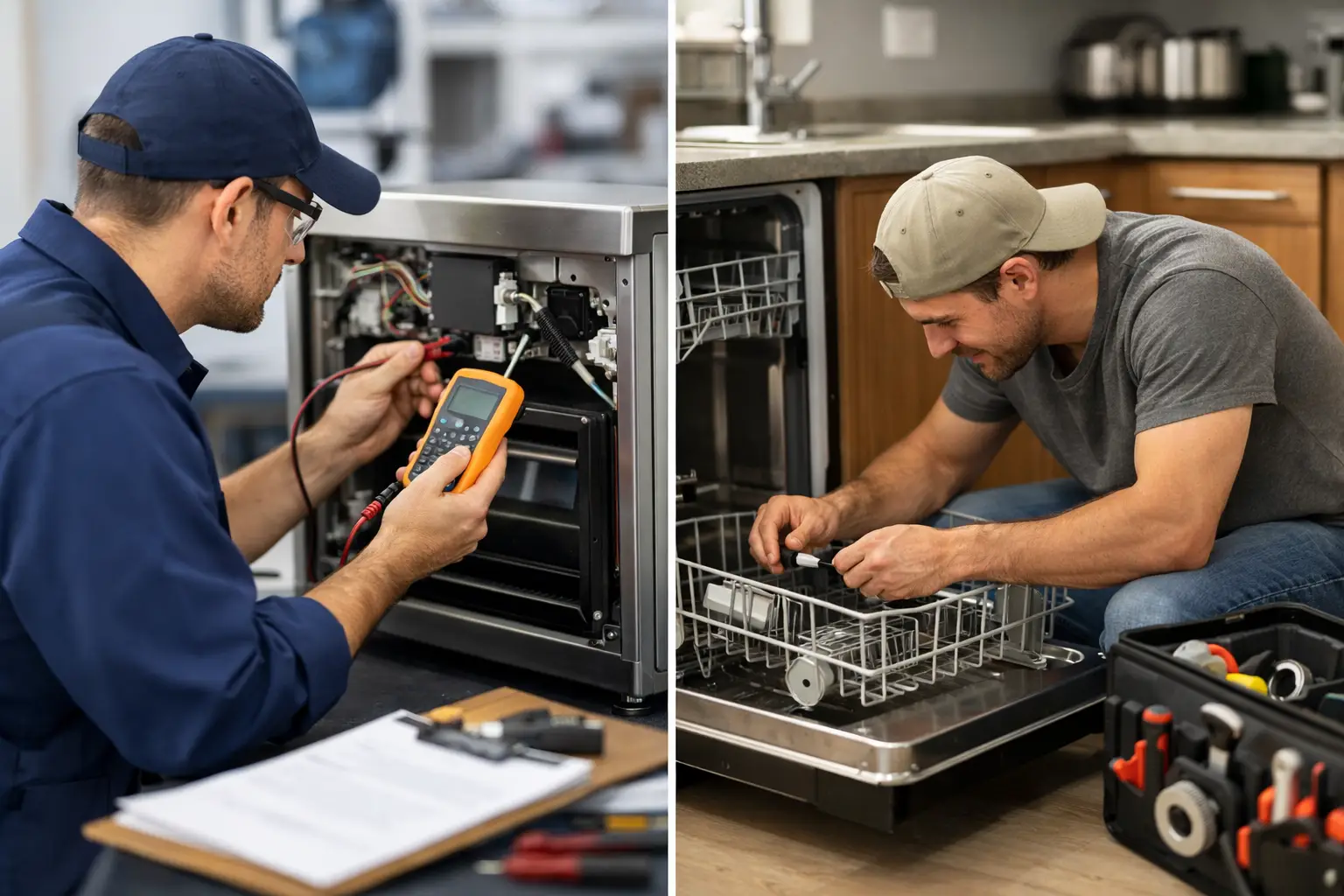
A homeowner does not care whether you learned a dryer repair from a cousin, a YouTube video, or a formal course. They care whether you can arrive prepared, diagnose the failure safely, explain the repair clearly, and leave the appliance running. That is the real decision behind appliance certification versus informal training: which route gives you a repeatable path to paid, reliable field work?
Informal learning can get you started quickly. Certification-based training can give you a system. For someone changing careers, looking for stable trade income, or planning to run an independent service business, that difference affects safety, callback rates, customer trust, and how fast you can take on more complex jobs.
What Informal Training Does Well
Informal training usually means learning through job shadowing, online videos, service manuals, trial and error, or helping an experienced technician. It is common in appliance repair because the trade has always had a hands-on side. Watching a technician replace a washer drain pump or clear a refrigerator defrost drain teaches practical details that a diagram alone cannot.
It also has a low barrier to entry. You can buy a basic meter, study a few common failures, and begin understanding how appliances are assembled. If you already work around maintenance, HVAC, electrical, or construction, informal exposure may help you recognize tools, wiring, and mechanical components faster.
The problem is consistency. One experienced technician may be excellent at diagnosing refrigeration problems but rarely work on microwaves. Another may know his local brands inside and out but use a diagnostic process he has never had to explain. Shadowing gives you access to real jobs, but it does not guarantee that you will see the full range of appliances, safety requirements, or failure patterns needed to work independently.
You can become capable through informal training. But you may spend months waiting for the right service call to appear, and you may not know what you have missed until a difficult job, an electrical hazard, or an expensive callback exposes the gap.
Appliance Certification Versus Informal Training in the Field
The biggest difference is not a certificate on the wall. It is whether you have a defined diagnostic workflow before the customer is standing in front of you asking, “Can you fix it today?”
Structured certification training organizes the work. You begin with safety, tools, electrical fundamentals, and meter use. Then you apply those skills across laundry, refrigeration, cooking equipment, microwaves, and dishwashers. Instead of memorizing random fixes, you learn how to verify a complaint, inspect the machine, test the correct circuit or component, confirm the root cause, and document the repair.
That process matters because appliance symptoms are often misleading. A refrigerator that is warm may have an airflow issue, a defrost failure, a bad thermistor, a control problem, or sealed system trouble. A dryer that will not heat may involve the supply voltage, thermal fuse, heating circuit, cycling control, or a restricted vent. Replacing parts based on a symptom is not diagnostics. It is gambling with the customer’s money.
Certification-oriented training also creates accountability. Graded coursework, simulations, and a final assessment force you to demonstrate that you understand why a test is performed, not just what a video showed someone else doing. That makes it easier to spot weak areas before they become field mistakes.
Safety Is Where the Gap Gets Expensive
Appliances combine line voltage, moving parts, sharp metal, high heat, water, capacitors, and, in some cases, high-voltage microwave circuits or refrigerant systems. Informal learning can normalize shortcuts because the person teaching you may have developed habits that work for them but are difficult to defend on a job site.
A structured program puts safety ahead of speed. That includes lockout/tagout practices, verifying voltage correctly, using a multimeter safely, recognizing when a capacitor may retain a charge, and knowing when a repair falls outside your authorized skill level. These are not classroom-only concepts. They protect you, the customer, and the business you are building.
Microwave service is a clear example. A technician needs to understand the hazards of high-voltage components and follow disciplined procedures. Refrigeration work presents another boundary: sealed system fundamentals are valuable, but proper recovery practices, equipment, and applicable regulations matter before taking on refrigerant work for pay.
Training does not remove the need for caution. It gives caution a procedure.
The Career Value of a Structured Credential
A certification is not a magic pass to six-figure income, and it does not replace real repair experience. A service company will still want to know whether you can communicate with customers, follow instructions, manage a job ticket, and make sound diagnostic decisions. Business ownership will still require marketing, scheduling, pricing, and disciplined follow-up.
What a credential can do is show employers and customers that you committed to a defined standard. For a new technician without years of service calls behind them, that matters. It gives your resume a clearer story than “I watched repairs online and helped a friend.”
The stronger advantage is the body of skills behind the credential. When you can explain a voltage drop test, identify a failed thermistor, read a wiring reference, or produce customer-ready documentation, you present yourself as a technician rather than a parts changer. That is what opens the door to better service opportunities and higher-value work.
Where Informal Experience Still Belongs
This is not an either-or decision for every learner. The best technicians keep learning informally for their entire careers. New models, error codes, control boards, and manufacturer-specific quirks will continue to show up after any course ends.
Informal experience is especially useful once you have a foundation. Job shadowing then becomes more productive because you can ask better questions. Service manuals make more sense when you understand wiring diagrams and component logic. Online videos become a reference instead of your only plan.
The risk is using informal learning as the foundation when your goal is to become job-ready fast. You may become very good at the failures you happen to see while remaining unprepared for categories your mentor does not service. A structured curriculum closes those predictable gaps first. Field experience then builds speed, judgment, and confidence.
What Job-Ready Training Should Include
If you are comparing programs, look beyond the word “certification.” Ask what you will actually be able to do after training. A useful program should teach safety and electrical testing before asking you to diagnose complex equipment. It should cover the major appliance categories rather than charging separate fees for each one.
It should also put you through realistic diagnostic scenarios. Reading about a failed lid switch is one thing. Working through the complaint, test sequence, probable causes, repair recommendation, and customer documentation is much closer to an actual service call.
Appliance Repair Academy is built around that field-ready approach. Its 12-week curriculum includes 80+ scenario-based simulations, graded coursework, a 75-question final certification assessment, instructor and community support, and training across the appliance categories technicians see most. Tuition also includes a 12-month subscription to the Appliance Repair Assistant AI app, a practical field tool for photo-based fault detection, error-code lookup, wiring references, multimeter guidance, job ticketing, and customer-ready reporting.
AI does not replace the technician holding the meter or making the final call. It helps a prepared technician find information faster, document work better, and stay organized between the driveway and the customer’s kitchen.
Choose the Path That Matches Your Goal
If you are fixing your own appliance, informal learning may be enough for a simple repair. If you have an experienced employer willing to train you across multiple categories and give you steady supervision, an apprenticeship-style path can work well.
But if you want a faster, more organized route into paid appliance repair, structured certification training gives you a broader launchpad. You build the safety habits, diagnostic workflow, technical vocabulary, and customer-facing process that let you keep improving on real calls. That is especially valuable if your long-term goal is independence, flexible scheduling, and a service business that can grow beyond one-off favors for friends and family.
Your first successful repair matters. Your hundredth repair matters more because it reveals whether you built a repeatable system or simply got good at improvising. Explore Appliance Repair Academy content and the companion AI-powered diagnostic app download resource to see how structured training and field tools can support your next move into the trade.