Microwave Repair Safety Training for Field Techs
Microwave repair safety training teaches technicians to control high voltage, test with purpose, and make cooking-appliance service calls safer every day.
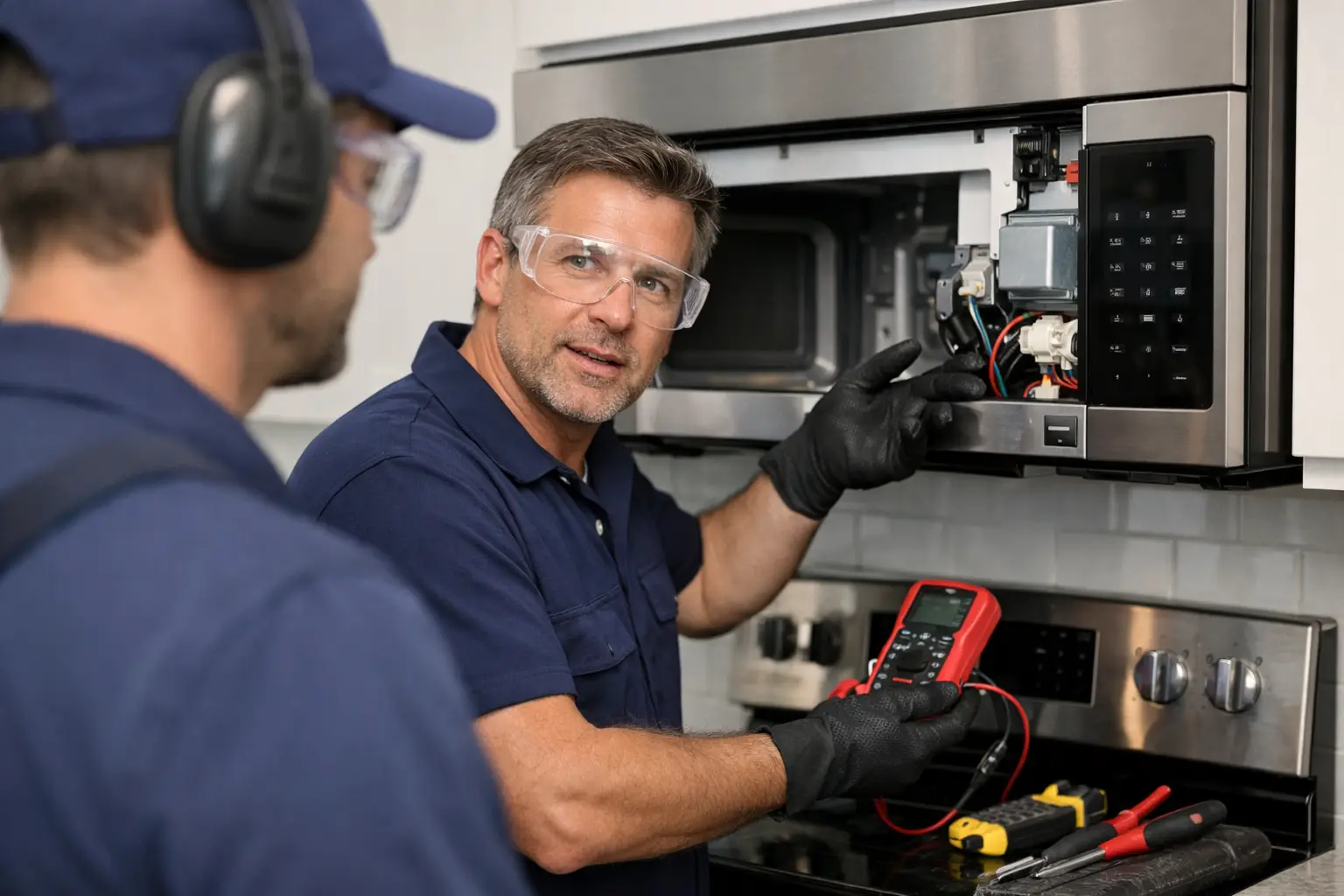
A microwave can look like a simple countertop appliance until the cabinet comes off. Behind that cover are high-voltage components capable of storing and producing dangerous energy, sharp sheet metal, heavy doors, and interlock circuits that must work exactly as designed. Microwave repair safety training gives new technicians a repeatable way to control those hazards before a meter lead touches a terminal.
For a technician building a career in appliance repair, this is not a side topic. Cooking-appliance calls are profitable, common, and often diagnosable in the customer’s home. But microwave work demands a different level of discipline than replacing a refrigerator water filter or troubleshooting a washer drain pump. The goal is not to be fearless around high voltage. The goal is to be methodical enough that fear never has to make the decision for you.
Why Microwave Repair Safety Training Is Non-Negotiable
Most household microwaves use a high-voltage system to power the magnetron, the component that creates microwave energy for heating food. That system can involve a high-voltage transformer or inverter, a capacitor, diode, magnetron, and associated wiring. Even after the appliance is unplugged, stored electrical energy may remain in the high-voltage capacitor.
That changes the job from routine component replacement to controlled electrical work. A technician who opens a microwave without a safety process can create a serious shock hazard, damage the appliance, or return a unit with compromised radiation containment. A technician with training knows where the hazards are, what condition the machine must be in before service begins, and when a repair should be stopped or escalated.
The business case is just as direct. Safe work protects the customer, your reputation, and your ability to keep earning. One careless service call can cost far more than the time required to follow lockout/tagout, verify de-energization, and document the repair properly.
Start With a Controlled Service Workflow
Safe microwave repair begins before the cabinet is removed. First, confirm the complaint and identify the appliance correctly. Record the model number, serial number when available, customer-reported symptoms, and any prior repair history. A microwave that runs but does not heat calls for a different diagnostic path than one that trips a breaker, sparks inside the cavity, or has a dead display.
Next, disconnect power. Unplug the unit when the plug is accessible. For built-in or over-the-range models supplied by a dedicated circuit, use the appropriate disconnecting method and follow lockout/tagout procedures. Do not accept a customer’s statement that the unit is off as verification. A switch position is not the same as an electrically safe condition.
Before entering the high-voltage section, inspect the exterior condition. Look for a damaged power cord, bent cabinet, loose door, broken latch hooks, cracked cavity coating, missing screws, or signs of heat damage. These details affect both safety and repairability. A badly damaged door or cabinet may turn a straightforward heating complaint into a replacement recommendation.
A strong workflow also separates low-voltage and high-voltage diagnostics. Many issues can be narrowed down through safe external checks, control behavior, door-switch operation, wiring inspection, and manufacturer test procedures before a technician needs to work near high-voltage components. That is not taking shortcuts. It is reducing exposure while collecting useful evidence.
Verify Your Meter Before You Trust It
A multimeter is only helpful when the technician understands its limits and confirms it is working. Inspect leads for damaged insulation, verify the meter’s category rating and settings, and prove the meter on a known source before and after testing where appropriate. This live-dead-live habit helps prevent false assumptions caused by a weak battery, failed fuse, wrong function selection, or damaged lead.
Microwave circuits may require resistance, continuity, diode, voltage, or capacitor-related testing depending on the design and manufacturer procedure. The correct test is determined by the circuit, not by guesswork. Random probing creates risk and can produce misleading readings that send the repair in the wrong direction.
High Voltage Requires Specific Rules
The high-voltage capacitor is the component every entry-level technician should respect immediately. It may retain a dangerous charge after the microwave has been disconnected from power. Never assume it has discharged on its own, and never use an improvised method such as shorting terminals with a screwdriver. That approach can produce an arc, damage the component, and place the technician in the line of danger.
Training should teach the approved discharge process, required personal protective equipment, insulated tools, and verification method for the specific appliance design. It should also teach body positioning. Keep hands, jewelry, tools, and loose clothing away from exposed conductors. Avoid creating a path across your chest, maintain a stable work position, and do not service energized high-voltage circuits unless the exact procedure, equipment, and competency requirements call for it.
There is a practical trade-off here. Some technicians try to save time by moving directly to the magnetron, diode, or capacitor because those parts are often associated with a no-heat complaint. That can be expensive guessing. A better technician follows the wiring diagram, understands the interlock sequence, checks for obvious failed connections, and tests components according to the manufacturer’s service data.
Door Interlocks Are a Safety System, Not Just Switches
Microwave door switches do more than tell the control board that the door is closed. They are part of a safety interlock system designed to prevent microwave generation when the door is open. Improper switch adjustment, damaged latch components, incorrect wiring, or bypassed interlocks can create an unsafe appliance.
Never bypass a door switch to “see if it works.” Never return a microwave with an interlock that has been modified, defeated, or poorly aligned. If the unit blows a fuse when the door opens or closes, the technician needs to diagnose the switch sequence, mounting, latch action, and wiring rather than simply replacing the fuse and hoping for a callback-free result.
After repair, inspect door alignment, latch engagement, hinge condition, and cabinet fitment. Reinstall every required screw and panel. The outer case contributes to the appliance’s electrical and radiation-containment design. A missing fastener is not a cosmetic detail.
Know When the Repair Should Stop
Professional training is not about forcing every appliance back into service. It is about making sound repair decisions. Stop and reassess when there is severe cabinet damage, a compromised door or viewing window, evidence of arcing that has damaged structural areas, burned wiring with an unclear root cause, water intrusion, or unavailable safety-critical parts.
The same standard applies to customer communication. Explain the finding in plain language, show the affected area when appropriate, and document the condition on the job ticket. A customer can decide whether to repair or replace, but they need accurate information to make that decision. Clear notes also protect your company if a declined repair involves a known safety concern.
For technicians working independently, this is where professionalism becomes a business advantage. Customers remember the person who explains why a damaged door latch matters, not just the person who quotes a part. Good documentation supports approval rates, reduces disputes, and creates a record for future service.
Build Skill Through Scenarios, Not Memorization
Reading a wiring diagram is necessary. Applying it in a no-heat call, a dead-unit call, or a door-switch fuse failure is what makes a technician employable. Effective microwave training should use diagnostic scenarios that require you to identify the symptom, secure the appliance, select the right test, interpret the result, and write a customer-ready recommendation.
That is the difference between memorizing that a magnetron can fail and understanding how to approach a microwave that powers on, turns the tray, runs the fan, but does not heat. It also builds the judgment to recognize when an inverter-based model requires a different procedure than a traditional transformer design.
Appliance Repair Academy builds that field mindset into its 12-week technician program with structured safety instruction, electrical testing, cooking-equipment training, graded coursework, and more than 80 scenario-based simulations. Students also receive a 12-month subscription to the Appliance Repair Assistant AI app, which can support photo-based fault identification, wiring references, multimeter guidance, job ticketing, and customer-ready reporting. The app supports the technician’s process. It does not replace the safety judgment required around high voltage.
Visit appliancerepairacademy.org to explore hands-on Academy training, and see appliancerepairai.org/download for the diagnostic app used alongside it. The safest microwave technician is not the one who moves fastest - it is the one who can slow the job down, control the hazard, and leave every customer with a repair they can trust.
Keep reading
Lockout Tagout Safety
Read moreTest Appliance Voltage
Read moreMultimeter Testing for Appliances
Read moreLearn this the repeatable way
The Appliance Repair Academy is a 12 week online certification taught by a working technician. Tuition is $949 and covers laundry, refrigeration, cooking, and dishwasher systems, with the Appliance Repair AI diagnostic app included for a full year.
Explore the program