What Appliance Repair Schools Should Teach
Compare appliance repair schools by curriculum, diagnostics, instructor support, and business training to choose a program built for paid field work today.
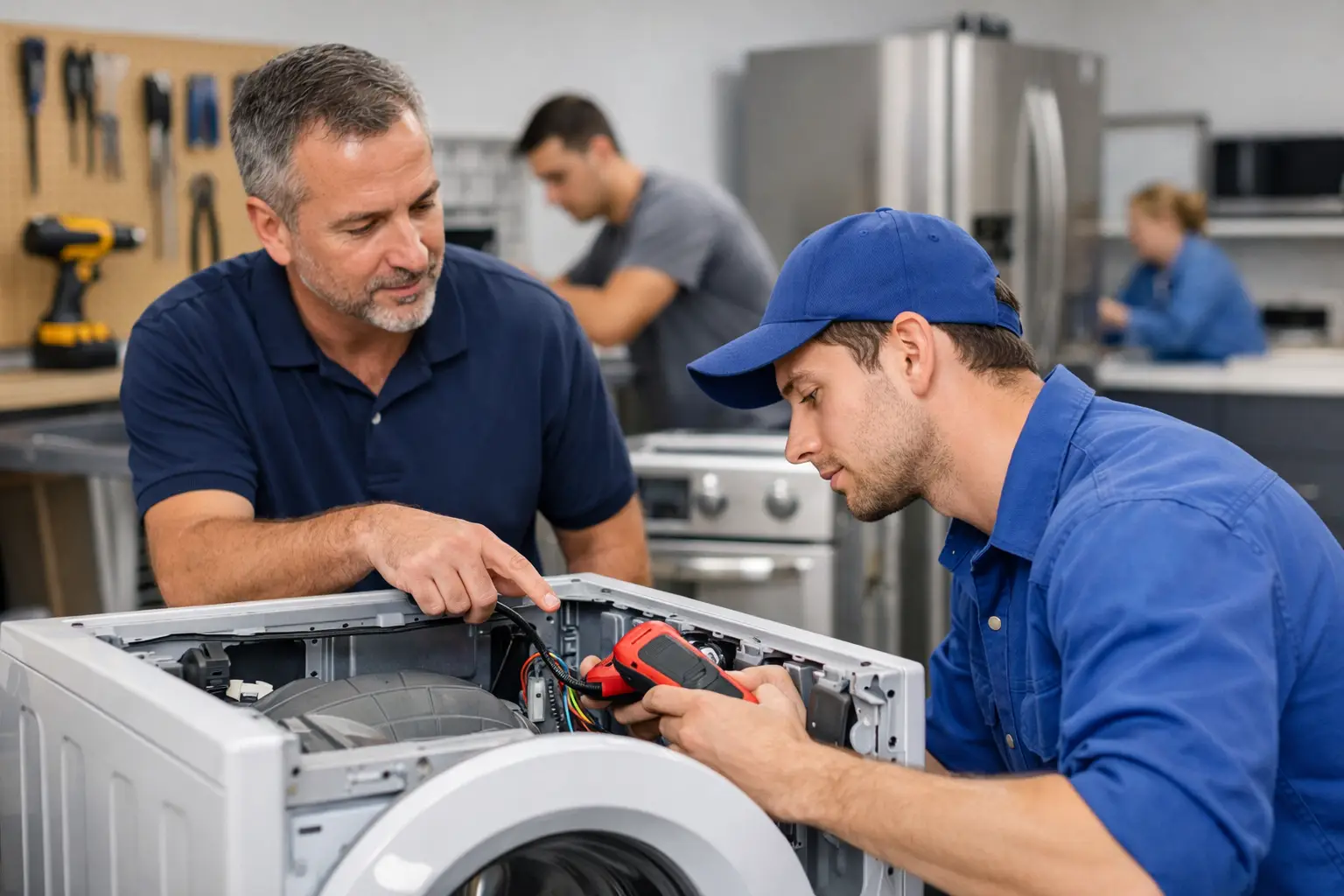
A washer that will not spin, a refrigerator with a warm fresh-food section, and a dishwasher that stops mid-cycle all look different at the customer’s door. Underneath, they demand the same thing: a technician who can work safely, test methodically, identify the failed system, and explain the repair clearly. That is the standard prospective students should use when comparing appliance repair schools.
The right program is not just a collection of appliance videos or a stack of service manuals. It should build a repeatable diagnostic process you can use on real service calls, whether your goal is getting hired by a local company or building an independent route of your own.
Appliance Repair Schools Should Train for the Service Call
A homeowner does not pay a technician to recognize a symptom. They pay for an accurate diagnosis, a safe repair, and a clear answer about what happens next. Training should reflect that reality from the first week.
Start with safety and electrical fundamentals. Before working on a dryer, range, microwave, or refrigerator, a technician needs to understand voltage, continuity, resistance, current flow, and proper multimeter use. That includes lockout/tagout procedures, capacitor awareness, grounding, and knowing when a circuit must be de-energized before testing. These are not background topics. They are the foundation for avoiding injury, preventing equipment damage, and protecting the customer’s home.
From there, strong instruction moves beyond parts identification. A student should learn how to read a wiring diagram, trace a circuit, verify power at the correct point, and distinguish between a bad component and a control board that is not commanding that component. Replacing parts based on a guess may occasionally solve a problem. It is not a business model.
A useful diagnostic workflow typically begins with the customer complaint, then confirms the symptom, checks installation and operating conditions, tests the relevant electrical path, and documents the conclusion. That sequence matters. It keeps technicians from replacing a door lock when the actual issue is a broken wire in the harness, or condemning a compressor before checking airflow, fan operation, and thermistor readings.
Look for Broad Category Coverage, Not Random Lessons
Appliance repair can become a durable career because households and property managers rely on multiple major appliances every day. A school should prepare students to work across the categories that generate service demand, not train them narrowly on one machine type.
Laundry training should cover washers and dryers from the standpoint of function and failure patterns. Students need to understand drain systems, lid and door switches, suspension issues, drive components, heating circuits, moisture sensing, airflow restrictions, and control communication. A dryer that tumbles without heat is a different diagnostic path than one that heats but takes two cycles to dry.
Refrigeration requires more depth because temperature complaints can come from airflow, defrost, sensors, fans, control logic, door sealing, or sealed-system issues. Good training introduces thermistor diagnostics, defrost circuits, evaporator frost patterns, condenser maintenance, and sealed system fundamentals. It should also draw a clear line between diagnosis and work that may require additional licensing, specialized equipment, or experience.
Cooking equipment, microwaves, and dishwashers matter just as much. Range and oven calls can involve surface elements, temperature sensors, igniters, relays, and high-voltage power. Microwave work requires unusually disciplined safety practices because stored high voltage can remain dangerous even after unplugging. Dishwashers bring together water fill, circulation, drainage, heating, leak diagnosis, and error-code interpretation. A school that treats these as afterthoughts leaves graduates with gaps in their service menu.
Broad coverage does not mean rushing through every model ever made. It means learning the operating principles that transfer across brands, then using model-specific documentation to confirm wiring, error codes, and component locations in the field.
Simulations Are Where Theory Gets Tested
Watching an instructor test a component is helpful. Deciding what to test next when a customer says, “It makes a noise but will not start,” is where confidence is built.
Scenario-based simulations are valuable because they force a student to connect symptoms, measurements, diagrams, and repair decisions. The best ones include misleading symptoms and incomplete information, because real calls do too. A refrigerator may be cooling poorly because of a failed evaporator fan, but the customer may describe it as “the freezer is making frost.” The technician has to translate the complaint into a diagnostic plan.
Look for programs with graded coursework and a meaningful final assessment, not simply video completion. A final exam does not replace field experience, but it gives students a measurable checkpoint before they begin representing themselves to employers or customers. It also reveals where they need another pass through electrical testing, wiring diagrams, or appliance-specific workflows.
Instructor Access Changes the Learning Curve
Independent study has advantages. You can train after work, move through lessons on your schedule, and avoid the cost and commute of a traditional campus program. But appliance repair is full of judgment calls that manuals alone cannot explain.
When a voltage reading looks wrong, when a wire diagram seems confusing, or when a symptom could point to three different systems, instructor access can keep a learner from reinforcing a bad habit. Community support is useful for the same reason. Students benefit from seeing how other technicians think through a no-drain dishwasher, an intermittent dryer heat complaint, or a refrigerator error code.
That support should be practical rather than vague motivation. Ask whether the program includes feedback on diagnostic reasoning, whether an instructor has current field experience, and whether students can get help interpreting a real repair scenario. Technician-built training carries more weight when the instructor understands time pressure, parts availability, return trips, and customer expectations.
Compare the Business Training, Too
Employment is a strong starting point for many new technicians. A service company can provide dispatch volume, exposure to different brands, and daily repetition that develops speed. For other students, the long-term target is an independent appliance repair business with control over scheduling, pricing, service areas, and customer relationships.
Either path benefits from business training. A technician must know how to write clear job tickets, document test results, communicate repair options, collect approval before ordering parts, and produce customer-ready reporting. These skills reduce disputes and make the work look professional.
For future owners, training should also address basic operational decisions: how to build a service call workflow, manage parts, estimate labor, handle callbacks, and set boundaries around work that falls outside your qualifications. Six-figure income is possible for skilled technicians and business owners in the right market, but it is not automatic. It depends on diagnostic accuracy, demand, pricing discipline, customer service, operating costs, and the ability to turn one successful call into referrals and repeat business.
AI Should Support Judgment, Not Replace It
Modern technicians have more information available than ever, but access to information is only useful when it fits the job workflow. An AI diagnostic tool can help a technician identify likely fault areas from a photo, look up error codes, reference wiring information, receive multimeter guidance, organize job tickets, and generate clear customer reports.
That is a force multiplier, especially for a new technician. It can reduce the time spent searching for documentation and provide a structured next step when the diagnosis stalls. It cannot safely bypass hands-on testing. A photo cannot confirm voltage at a relay. An error code does not always identify the failed part. A professional still verifies the condition with proper tools and follows the manufacturer’s service information.
The strongest training programs teach students how to use technology without becoming dependent on it. Learn the system, take the measurements, document the evidence, then use digital tools to work faster and communicate better.
A Practical Standard for Choosing a Program
Before enrolling, compare appliance repair schools against the work you want to be able to perform in 90 days. Can the program take a beginner from electrical safety and multimeter basics through laundry, refrigeration, cooking, microwaves, and dishwashers? Does it provide realistic diagnostic simulations, graded work, instructor support, and a final assessment? Does it prepare you to document a job professionally and understand the business side of paid service?
Appliance Repair Academy is structured around that progression in a 12-week format, with 80-plus scenario-based simulations, a 75-question final certification assessment, direct support, and a 12-month subscription to the Appliance Repair Assistant AI app included with tuition. The goal is not to make students memorize every part number. It is to help them show up prepared to diagnose, communicate, and keep building field experience.
Choose training that makes you more useful on the next service call, not merely more familiar with appliance terminology. Explore the Academy’s program content for the training path, then download the companion AI-powered diagnostic app to see how structured field tools can support your hands-on work.